

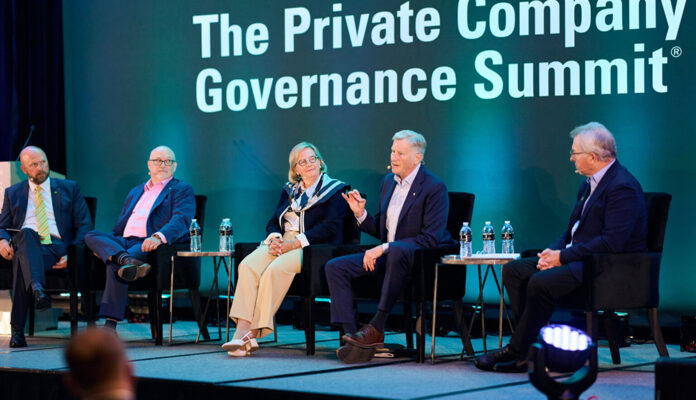
In his panel session at The Private Company Governance Summit 2025, Wolfe Tone, global Deloitte Private leader, had an unenviable task as moderator of the conference’s lead panel: identify and explore the five issues that will most impact private companies in the next 15 years … and do it in 45 minutes. The time flew, as did the insights, thanks to an all-star panel including Vitamix chair David Barnard, Hussey Seating Company chair Letitia Hussey Beauregard, Graebel Companies chair Bill Graebel and Griffith Foods executive chair Brian Griffith.
The first topic discussed was talent and workforce transformation. According to Graebel, issues around talent are exacerbated by an aging population, labor shortage and sizeable skill gaps. Graebel says his company is addressing these issues by focusing more intently on their value proposition.
“There are some key things that underlie your employer value propositions and how you attract, develop, advance, promote and retain your people,” said Graebel. “That’s a critical, strategic muscle we’re going to have to keep working on, keeping our ears to the ground to understand what the workforce of not only today but tomorrow expects.”
One of the issues Graebel thinks he will have to remain apprised of is attitudes around workplace dynamics. In other words, are employees inclined to return to the office or do they prefer working from home (or some combination of the two)? Either way, Graebel believes private companies will need to track the preferences of the now-35-year-olds who will be serving as leadership in the next 15 years.
“There’s a real conundrum in terms of how are you going to establish, maintain and grow your culture going forward,” said Graebel. “These are really interesting times, but I think companies that can demonstrate and resonate their values and have those values aligned with the mission and purpose of the organization are going to have a better chance of attracting and retaining valuable talent.”
The second major issue of the next 15 years was digital investment. Griffith spoke about how Griffith Foods, a company that creates the secret proprietary seasoning, sauce and marinade recipes for some of the world’s most-loved food brands and restaurant chains, has created a digital road map around its core processes.
“It is important to have a clear focus around key processes that really drive strategic value and have those automated,” said Griffith. “Consequently, we’ve developed a digital master plan, now including AI, that is frequently reviewed and proactively updated.”
Development of that road map includes the company’s seven independent directors, its four sustainability advisors and search partners they work with to identify people who are “brilliant in terms of data analytics, as well as perspectives that we may not have considered yet.”
As his company seeks to apply more AI processes around recipe development, Griffith stresses his goal is not to replace people, but to help bolster their ability to perform their roles. To do that effectively, the quality of data is essential to any digital effort, especially AI.
“At this moment in our evolution, ‘AI-assisted’ is the way we are looking at our critical processes,” said Griffith. “Being able to relieve routine or very time-consuming activities to provide a higher productivity baseline where people are enabled to focus on the value-added activities of understanding the ‘why’ behind the analytics, complex problem-solving and creative solutions is where we’re striving to go.”
As for bringing AI expertise onto the board, Griffith said, at this stage, they are asking their directors and advisors to identify outside experts for broader exposure to unique perspectives and practical use cases, simply because of the speed at which AI is moving.
“It’s hard to bring someone who is a digital expert on to your board because, depending on their age or what they are doing, they may or may not be relevant three years from now,” Griffith said. “We have found that reaching out to a variety of expert sources is most helpful.”
When Tone asked Barnard to address the third major issue — the evolving state of governance transparency and stakeholder trust and the skills and perspectives that will be needed in the boardroom as we move toward 2040 — he stressed the key will continue to be bringing diversity of thought into the boardroom. This means members of the next generation, as well as people who have not yet achieved C-suite positions, who Barnard says can often offer unique positions to individuals who have served exclusively on boards for an extended period of time.
“I was talking to our CEO and I asked him which prospective board candidate he likes best. And he said the people who are closer to the C-suite are more relevant to the questions that I am asking about,” recalls Barnard.
At the same time, he did not discount the experience brought by long-time board members, stating that what is most valuable is a mix of perspectives.
“There is definitely a lot of value in governance from people who can temper stress and anxiety. The sense of calm needs to be there,” Barnard says. “So, you need a mixture of that sort of experienced temperament and newer people that understand how hot the iron actually is.”
Tone’s fourth issue was geopolitical and economic volatility. According to Beauregard, the best way for a board to handle that is via communication and transparency with their shareholders.
“You want to be transparent at different levels,” said Beauregard. “The more you can talk to your stakeholders, understand what everybody’s expectations are and try to plot out where the world is going and how we fit into it, the better chance that you will come together and have the same goals.”
Of the 190-year-old Hussey Seating Company, Beauregard said, “Our motto is we’re in it for the long haul. But we have a responsibility. I feel that responsibility myself as chair — and so do the board and the shareholders of the sixth and seventh generation — to make sure there’s another 190 years.”
The fifth issue discussed by the group during the panel was one that threatens more than just family business, but the wider society itself: climate change and resource scarcity. For an organization like Graebel Companies, which operates on a multinational scale, it becomes necessary to navigate a variety of regulatory regimes around sustainability. Graebel says they accomplish this by making compliance a baseline ingredient of the company’s risk management.
“We scour the landscape and look for the environmental, tax, legal and employment requirements that we are going to have to be accountable for,” says Graebal. Those factors are then plotted into an enterprise risk matrix and ranked by the likelihood of their occurring as well as their severity and the impact that they would have on the company. Then the Graebel board’s audit committee, along with the internal audit team, establishes workflows, timelines and reporting requirements for each scenario.
“So then you have a visual for authenticating your compliance and you can work backwards from any milestone dates that you have to comply by,” said Graebel.
As for environmental compliance successes, Graebel believes it is important to communicate them to company leadership, but also the workforce as a whole.
“That’s all part of nurturing the knowledge and talent inside your organization.”