

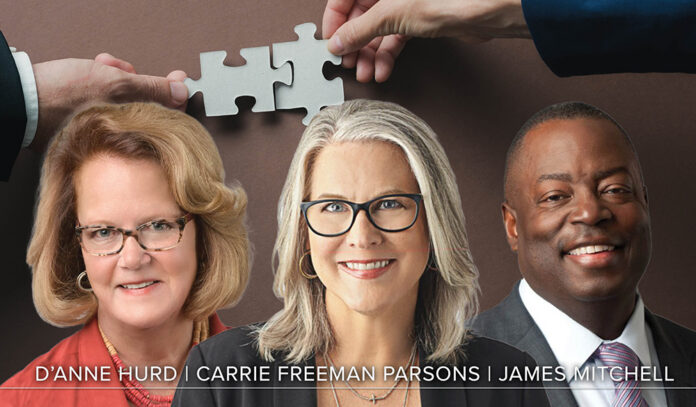
In an era defined by constant disruption, including geopolitical volatility, technological acceleration, shifting stakeholder expectations and compressed decision cycles, many private company directors are reexamining how to apply one of governance’s oldest maxims: NIFO, or “noses in, fingers out.” What does effective oversight look like as directors weigh their fiduciary duties and oversight role with risks that are multidimensional, fast-moving and deeply interconnected with strategy?
“A healthy relationship with the CEO is rooted in understanding that the board members are a bridge between the company and the family, employees or other key shareholders,“ says D’Anne Hurd, who is a director of Martin Engineering and Centier Bank “As a board member of a private company, you will find that you’re called upon to weigh in on things much more. You go where you’re needed. You just flow to where the problem is.”
In order for the CEO to have a healthy level of give-and-take, it has to be rooted in mutual trust, says Carrie Freeman Parsons, board chair of Freeman. “The board’s relationship with the CEO has to start with psychological safety. The CEO must believe that the board wants that CEO to be successful.”
Fostering a culture of trust also helps ensure a healthy flow of information to the board with less gatekeeping. “I want to make sure that the CEO would be comfortable in coming to me and saying ‘I made a mistake,’” says Hurd. “And I go out of my way to make sure that I tell the CEO when I think I’ve made a mistake. There’s nothing that builds trust more than admitting that you’re wrong.”
Ultimately, the board’s governance role is to ensure the company is well-run, and central to that is enabling the CEO’s success. So how do boards balance supporting the CEO, building the trust necessary to maintain a healthy level of information flow and providing the perspective they’ve been hired for with ensuring they don’t cross the line into management?
Generally speaking, the board should have a broad perspective and point of view over the “what,” but should leave the “how” to the leadership team, says Parsons, “the board’s role is to say, ‘These are things we care about and we have expertise if you’d like to tap into it. We’re happy to share our perspective, but at the end of the day, we’re not going to get into the weeds of how you do your plan. We’re going to check and ensure you are following the plan that has been set out. It’s not our job to micromanage how you execute it.’”
James Mitchell, who serves on the boards of Horizon Blue Cross Blue Shield of New Jersey, Azuria Water Solutions, Fora Financial and the New York State Common Retirement Fund, agrees. “I try to balance being a part of critical discussions and not being heavy-handed, but helping to guide the CEO.” He cites an example from one of his boards where the company was looking for a new CFO. “I said, ‘Look, I don’t need to meet every CFO candidate, but when you decide on the top two, bring the profiles to me and I will offer my view on the top candidates. Then, the final decision is left to the CEO and the other members of the senior leadership team. As a board leader, my role is to leverage my decades of corporate and operational experience to help the CEO make good decisions. I’m the outside guy who can give you a perspective that maybe you can’t see.”
There are some key areas where the board should take a leading role. “As chairman, my role is to focus on three things: strategy, growth and succession,” says Mitchell. “I want to know, what’s the three-year plan? How are we going to grow? Do we have the right people in the senior leadership team that can make that strategy a reality? If you don’t, what are you going to do about it?”
In addition to strategy, Hurd emphasizes the essential need for the board to “trust but verify” when it comes to anything having to do with oversight of financial controls. “The internal audit function, by definition, should be independent of management,” says Hurd. “The job is to double-check management. So, as audit chair, I need to be involved and the board needs to be involved in it.”
The line between the role of the board and the role of management is often tested during times of crisis, when directors may lean in harder to ensure the CEO is in a position to understand the severity, potential short- and long-term implications, and how to mitigate damage. “When a crisis comes, I immediately want to know what’s going to be the impact on the income statement and to customers,” says Mitchell. “I want to know how much time senior management will need to dedicate to this crisis. And does the current management team have the expertise to handle this or do we need to bring in some big guns?”
In a best-case scenario, the board will have assurances the CEO has their arms around the key issues and can serve as a thought partner and sounding board on how best to proceed. But if the board does not feel comfortable, they can panic and lean in harder in ways that can confuse roles and responsibilities, which can thwart their ability to be effective at best and potentially exacerbate a crisis at worst.
To that point, a crisis can also be a real-time stress test of a company’s governance, exposing whether information flow and healthy debate between the board and leadership are fit for purpose. “When a crisis hits, it’s important that the board remember we can’t all jump into all things, so we’re going to focus on the most critical issues that are being impacted as a result of the situation,” says Parsons, “your ability to do that is predicated on the rigor that is present when you’re not in crisis. So, if the board doesn’t really understand the financials, if you don’t have a really good view of your cashflow over a long period of time, if you don’t have all those things in good times, then when the stuff hits the fan, everybody panics because they don’t even know what good looks like. That, to me, is the most important thing is to ensure that your board is well-oriented, well-informed, well-connected into the levers that matter the most, the biggest business drivers for the business, so that if there is a crisis that impacts them, they know at least what the baseline is and what you’re trying to work toward.”
How can a board tell if the relationship between the directors and the CEO or a member of the senior leadership team has gotten to the point where objectivity might be compromised? One sign is if the board has become too deferential to the CEO to the point its impeding healthy levels of give-and-take. “If there’s no healthy discussion and positive debate, that’s when you know it’s out of balance,” says Parsons.
Another issue to look for is if the relationships between directors and the CEO and leadership have crossed from collegial to cozy. The key is fostering trust without overstepping, and that comes down to creating and enforcing clear boundaries, says Mitchell. “Too much closeness is dangerous: It can cause loss of objectivity, create blind spots, foster groupthink and add unwarranted risk to the business model.” Mitchell’s core operating philosophy when it comes to the CEO? “We’re not pals. We are business colleagues. Therefore, no shared vacations and no social entanglements that make objectivity harder. When the relationship becomes too close, you can lose your objectivity. And when I’ve seen that with other directors, I’ve had to reign that in. It’s very difficult as an independent director and fiduciary be objective if my wife and your wife are pals and our kids go on vacation together. We’re in the business of business. If everybody’s thinking alike and everybody’s trying to get everyone’s best interest in mind, it’s more difficult to have hard discussions when you need to have hard discussions.”
In some cases, the issue is not the board overstepping but the CEO being over-reliant on the board for guidance. Hurd cites an example from early on in her board career where she had a standing call every Saturday with the CEO who wanted advice on business issues. “As a board member, you have to decide how much time you want to spend advising the CEO of the company. Any board member should know that, in a private or a public company, you are going to be expected on some occasions to be a trusted advisor. It will happen more frequently with a private company, and you need to know about that going into your board service. You really need to decide what your bandwidth is and what your capacity is.” Hurd shares a helpful reframe that can give the CEO the perspective he or she is looking for, while respecting the distinct roles of both the board and CEO. “In those cases, I say ‘My instinct says that this is really your decision, but you’re asking me for my advice, so let me think on it and come back to you.’” This allows the director to gather their thoughts and be intentional about the input, while reinforcing the purview and role of the CEO. Ultimately, says Mitchell, if the board stays focused on the key drivers of the business, it should provide a road map for healthy board interaction. “I used to work in national politics and I had a mentor tell me, ‘You must remember: The main thing is the main thing. For us, as board members, it means keeping the company’s mission and objectives first.”