

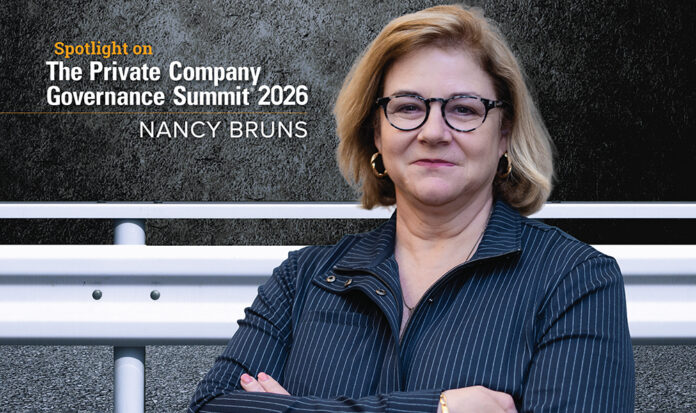
As we ramp up for The Private Company Governance Summit 2026, which will take place June 10-12 in Washington, D.C., we are speaking to our panelists to get a bit of insight on the topics they will be discussing at the event. Today, we speak with Nancy Bruns, seventh-generation owner and chair of Dickinson Family Holdings Company, about the subject matter of “From Guardrails to Growth: The Board’s Strategic Role,” the session she will be participating in at PCGS 2026.
Private Company Director: What does effective strategic involvement from the board look like in practice? Specifically, where is the line between shaping strategy and stepping into management?
Bruns: Effective strategic involvement requires clarity of roles, but also strong collaboration. The board is responsible for setting long-term direction, while management executes. In practice, however, the line is not rigid. It depends on communication, trust and shared goals.
Strategic planning is essential. Without clear objectives, businesses risk stagnation. The most effective approach is a partnership: The board provides oversight and long-term perspective, while management contributes operational insight. Neither can succeed independently.
I lead a 200-plus-year-old family enterprise currently navigating a period of transition. In 2021, I succeeded a cousin who had led the business for more than 40 years. During his tenure, the company operated with a largely passive model — generating income through royalties and rents and evaluating opportunities as they arose. It was steady and successful, guided by an “If it isn’t broken, don’t fix it” philosophy.
As I stepped into leadership, I saw the need to shift from passive to active. Rather than waiting for opportunities, we began seeking them out. Around this time, we engaged a strategic advisor to bring an external, objective perspective. Together, we have worked to define a clearer direction and engage both the board and management team in shaping the future.
Our structure adds complexity. We do not have a traditional CEO. Instead, I serve in a hybrid chair/CEO role. A key initiative has been launching an active land development business in West Virginia, supported by a VP of real estate development. She manages day-to-day execution, while I remain involved in planning and key decisions.
This creates a gray area between governance and management, but it reflects the reality of building something new within a legacy enterprise. As the business matures, I expect these boundaries to become more defined.
Ultimately, effective strategic involvement is less about rigid lines and more about judgment — knowing when to engage deeply and when to step back to ensure long-term success.To hear more from Nancy Bruns, register today for The Private Company Governance Summit 2026.