

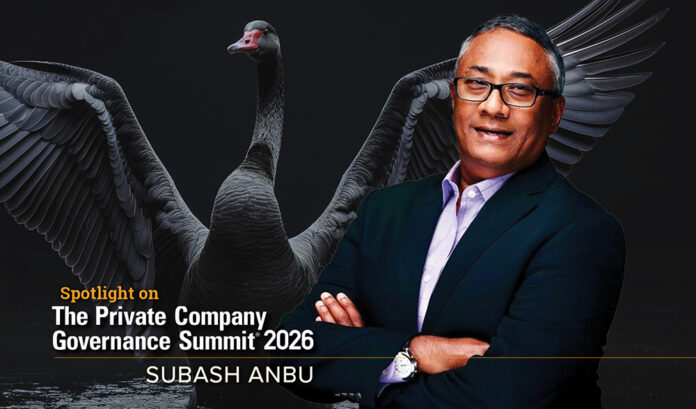
As we ramp up for The Private Company Governance Summit 2026, which will take place June 10-12 in Washington, D.C., we are speaking to our panelists to get a bit of insight on the topics they will be discussing at the event. Today, we speak with Subash Anbu, director of Field Fastener, about the subject matter of “How Private Company Boards Turn Risk Into Opportunity,” the session he will be participating in at PCGS 2026.
Private Company Director: Are boards truly seeing the risks that could redefine their business or just the ones they already know how to manage? How can boards better recognize risks to which they have not previously been exposed – the so-called black swans?
Anbu: “Just when you thought it was safe to get back into the water” — the tagline from the movie Jaws — is how the month of March 2026 has turned out to be, especially for the stock market. Since post-COVID, boards of companies have (or at least should have) learned the need to prepare for the unknown unknowns. While we have updated business continuity plans in place, how do boards prepare for recent risks, such as the Ukraine/Russia conflict, tariffs and the Iran war? Is this the new normal? While boards don’t have a crystal ball, they need to ensure that their risk framework has some broad categories that need to be reviewed/evaluated quarterly (not annually). Boards always need to plan for black swan events while being optimistic. It’s about adjusting the sails and not just raising or lowering them. Although political risk experts, such as Ian Bremmer, talk about the “G-Zero” world, the world is still flat and interconnected in terms of supply chain, cybersecurity and financial markets.
Risk management should be part of the strategic planning process. The what-if scenarios of growth opportunities enabled by AI, innovation and mergers and acquisitions need to be counterbalanced with the risks attributed to geopolitical events, technology disruptions, natural disasters, biological warfare, terrorism and cybersecurity. Boards should remain proactive in considering potential groundbreaking innovations that could transform their respective industries while keeping in mind the new risks that may arise, much like the invention of the airplane and the parachute. In other words, their current risk management frameworks need to be continuously updated for the future.
The phrase “private and/or family company,” especially the larger ones, is a misnomer in the sense that there is very little that is private about it. These companies cannot and do not operate in a vacuum, meaning they may have customers and suppliers who are public companies. It comes down to the culture of the company at the end of the day. Boards need to ensure that companies have sound governance frameworks and supporting culture, people, processes and systems for both innovation and risk management.
To hear more from Subash Anbu, register today for The Private Company Governance Summit 2026.