

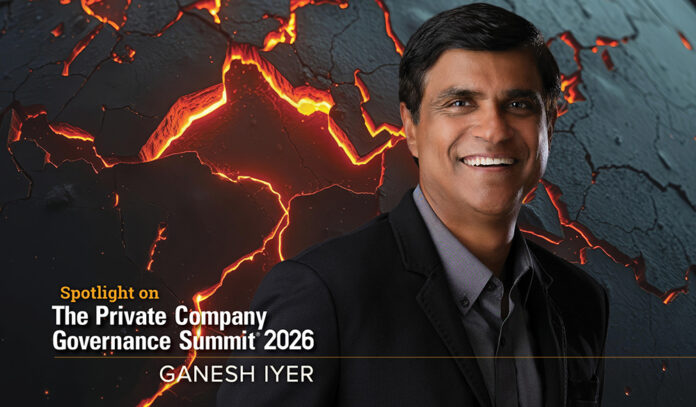
As we ramp up for The Private Company Governance Summit 2026, which will take place June 10-12 in Washington, D.C., we are speaking to our panelists to get a bit of insight on the topics they will be discussing at the event. Today, we speak with Ganesh Iyer, president and CEO of Etnyre International, about the subject matter of “How Close Is Too Close? Navigating the Board/Management Relationship,” the session he will be participating in at PCGS 2026.
Private Company Director: How can a private company board know that, when pressure rises, the relationship between their board and management strengthens decision-making and doesn’t hamper it? What are the tell-tale signs of a relationship that is off and how can they be addressed?
Iyer: A private company board can assess whether its relationship with management strengthens decision-making under pressure by observing whether stress produces greater clarity, speed and alignment rather than hesitation or second-guessing. In a strong relationship, roles sharpen in moments of pressure: Management brings clear facts, options and recommendations, while the board contributes perspective, challenge and judgment. Decisions may be difficult, but they are timely, owned and followed by consistent execution. Transparency increases. Bad news surfaces early and discussions are candid, and once decisions are made, both sides present a unified voice internally and externally.
Tell-tale signs of a relationship that is off often emerge quickly under stress. These include blurred roles, where directors drift into operating decisions or management bypasses governance on critical matters. Trust erosion may show up as delayed or filtered information, overly polished presentations or “data dumping” without insight. Meetings become ineffective, revisiting the same issues without resolution, raising important topics informally or allowing either board or management to dominate while the other disengages. In more acute cases, decision-making slows, messaging becomes inconsistent and visible tension emerges between the CEO and board leadership.
Addressing these issues requires an intentional reset. Boards and management should reaffirm role clarity, often through a simple operating charter that defines decision rights, escalation thresholds and information standards. Strengthening key relationships, particularly between the chair and CEO, helps surface tensions early and align on priorities. Improving meeting design is equally important: Focus on forward-looking scenarios, clear decisions and accountability rather than retrospective reporting. Normalizing feedback through post-event reviews and ongoing dialogue builds trust and reinforces behaviors before the next period of pressure.
Ultimately, when pressure sharpens alignment and accelerates decisions, the board/management relationship is functioning as a true force multiplier.
To hear more from Ganesh Iyer, register today for The Private Company Governance Summit 2026.