

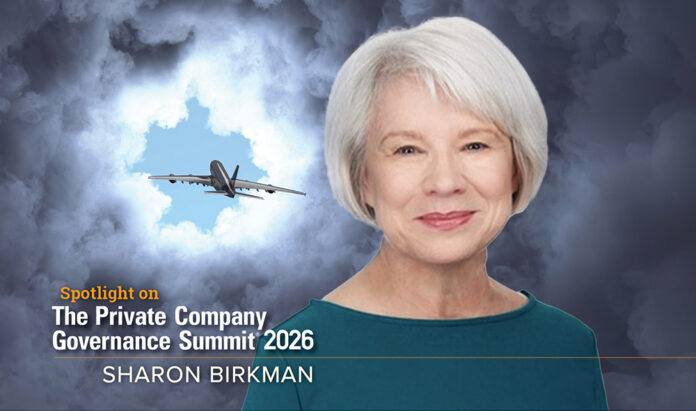
As we ramp up for The Private Company Governance Summit 2026, which will take place June 10-12 in Washington, D.C., we are speaking to our panelists to get a bit of insight on the topics they will be discussing at the event. Today, we speak with Sharon Birkman, second-generation owner and chair of Birkman, about the subject matter of “How Close Is Too Close? Navigating the Board/Management Relationship,” the session she will be participating in at PCGS 2026.
Private Company Director: When a company hits turbulence, how can boards stay deeply engaged on strategy and performance without crossing the line into micromanagement, and where should that line be drawn in practice?
Birkman: As a privately held family business, having a board is optional. For years, however, we have chosen to maintain one. Historically, it functioned as an advisory board, but today it is fiduciary. As we work through my succession plan, I needed a board with “teeth,” one strong enough to help address the headwinds of transitioning from a second-generation family business.
Years ago, while serving on my father’s board, I rarely saw meaningful debate or pushback, even when I felt it was warranted. That experience made me question the value of a board, given the significant investment of time and money, and I worried about creating a rubber-stamp group. Fortunately, my current board has proven the opposite. They care deeply and are willing to challenge me.
While I have not always agreed with their advice, they have consistently protected both me and the company, especially during a difficult family business situation. They have supported my leadership and offered sound, objective guidance when it mattered most. Two directors even stepped into interim operational roles to support new initiatives, gaining a deeper understanding of our challenges.
How close is too close?It is a dynamic and delicate balance. As chair, I aim to hold my board like a precious butterfly, with care and respect. While independent board directors play a critical role, they are not owners.
My goal is to listen, learn and benefit from their wisdom without micromanaging. Ultimately, I must trust my own best instincts. As we move forward, we are thoughtfully transitioning those directors back into their traditional roles.
To conclude, even though I’ve not always agreed with them, they’ve never been a burden or a hindrance: They’ve been Birkman heroes who contribute by their ability to gracefully fly in and out of the company.
To hear more from Sharon Birkman, register today for The Private Company Governance Summit 2026.